
A cold room drifting out of range is a clock, not a fault report. What you do in the first half hour decides how much of the stock survives. This is a practical order of actions.
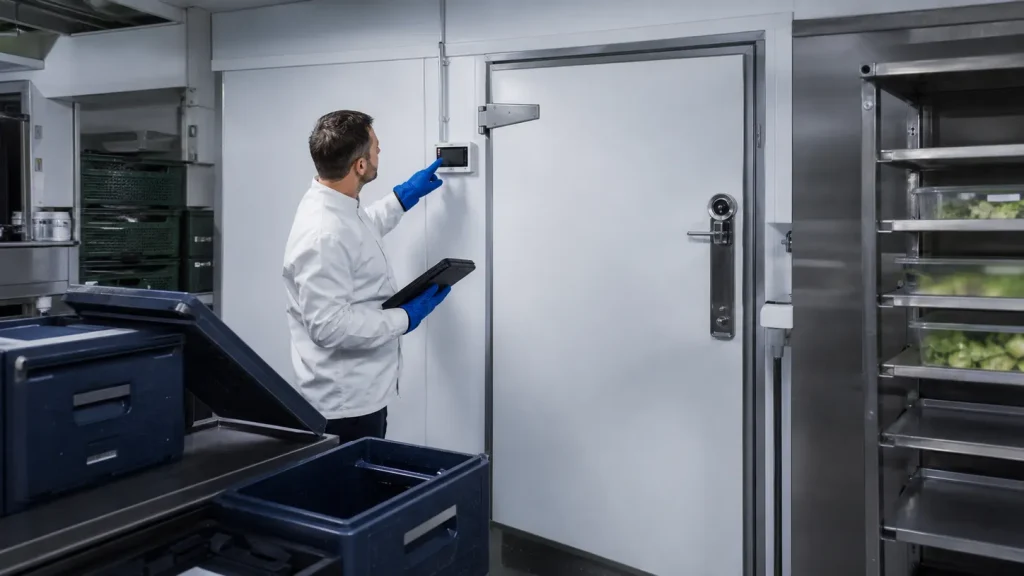
First, check the things that are not a breakdown
A surprising number of urgent call-outs turn out to be one of these, so they are worth thirty seconds before anything else:
- Is the door properly shut? Including whether something is propping it, or a pallet is fouling the seal.
- Has it been switched off? Check the isolator and the plug. Cleaning and deliveries both move things.
- Is it in a defrost cycle? A temporary rise during defrost is normal behaviour, not a fault.
- Has the setpoint been changed? Controllers get adjusted by well-meaning people.
- Has something warm just gone in? A large delivery of ambient stock will pull the temperature up until the system catches back up.
Protect the stock
Do not wait for a diagnosis before acting on this. If you have spare capacity elsewhere — another cold room, a van, a neighbouring business — start moving the most valuable and the most temperature-sensitive stock now. Keep the door closed as much as possible while you do it; every opening costs you time you do not have.
If you cannot move it, at least identify what is at risk and what your food safety procedures require you to do about it.
Write down what you are seeing
Note the time you noticed, the temperature then and now, whether the unit is running, and anything unusual — ice, water, noise, alarms. Two reasons: it helps whoever attends diagnose faster, and if stock has to be discarded you will want the record.
If you have temperature monitoring or a data logger, do not let it be overwritten. That log is your evidence of how long the excursion lasted.
What not to do
Do not open up the equipment. Do not chip ice off a coil with anything metal — puncturing an evaporator turns a repair into a replacement. Do not keep resetting a tripping breaker; it is tripping for a reason and repeatedly resetting it is a fire risk.
If you can smell burning, see smoke or sparking, or there is water near live electrical equipment, isolate the supply if it is safe to do so and call the relevant emergency service before you call a refrigeration engineer.
When to call
Once you have ruled out the simple causes, call. Do not use a contact form for this — forms arrive in an inbox and are read during office hours. A telephone call reaches a person who can start asking the right questions immediately.
For Millennium customers that number is 0800 952 0081.
What you will be asked
Having these to hand shortens the call considerably:
- Business name and site address or postcode
- A number you can be reached on
- What the equipment is and roughly how old
- What temperature it should hold, and what it is holding now
- Whether it is completely off or running but not achieving temperature
- Whether stock is at risk, and roughly what value
- Whether you hold a maintenance agreement
Afterwards
When the immediate problem is dealt with, the useful question is why it happened. A cold room that fails once because a condenser was choked will fail again on the same schedule unless the cleaning interval changes. Planned maintenance exists precisely to convert this kind of event into a routine visit.
Related services
Emergency repairs · Commercial refrigeration · Planned servicing & maintenance