
“Planned maintenance” covers a wide range of things, from a genuine service to someone glancing at a thermometer and leaving a sticker. If you are comparing quotations, it is worth knowing what the work should actually involve.
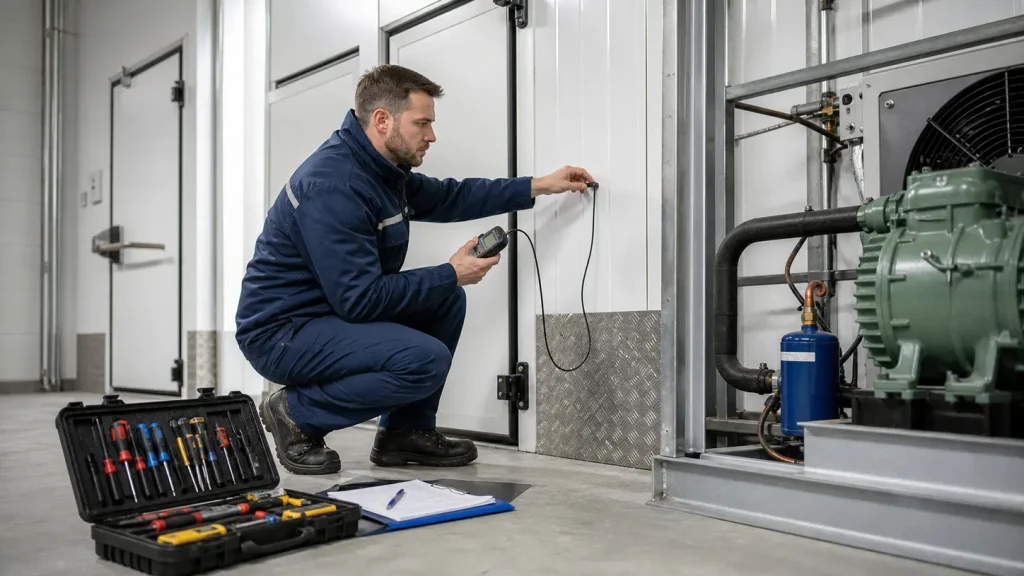
Performance and temperature checks
Not just “is it running” but “is it holding what it is supposed to hold, and how hard is it working to do it”. Operating pressures and temperatures tell an engineer whether a system is comfortable or struggling long before it fails.
Condenser and evaporator cleaning
This is the part that most affects your running costs and the part most often skipped. A condenser blocked with dust and grease cannot reject heat, so the system runs longer and hotter to achieve the same result. In a commercial kitchen the fouling rate is high enough that cleaning frequency, not cleaning quality, is usually the deciding factor.
Electrical and control checks
Connections work loose with vibration and thermal cycling. Contactors pit and burn. Thermostats and controllers drift or get adjusted by someone who thought colder must be better. All of these are cheap to find on a visit and expensive to find on a breakdown.
Door seals, hinges and closers
On any door that gets real traffic, gaskets and hardware are consumables. A perished seal admits warm, moist air continuously — which shows up as ice on the evaporator, longer run times, and a bill you cannot account for.
Drainage and defrost
Condensate drains block. Defrost heaters fail, and defrost timers get left on settings that suited a different pattern of use. A visit should confirm the drain is clear and that the defrost cycle is actually doing its job on the schedule the equipment needs.
Refrigerant and leak checking
A system low on refrigerant is a system with a leak; refrigerant is not consumed in normal operation. Beyond the performance problem, there is a legal dimension here. Under the F-Gas rules, operators of equipment containing fluorinated refrigerants above certain charge sizes must have leak checks carried out at set intervals and keep records of them.
The thresholds and intervals depend on the refrigerant and the charge in your particular system, and the checks must be carried out by suitably qualified personnel. If you are not certain which obligations apply to your equipment, that is a reasonable question to put to your contractor before agreeing a contract — and a contractor who cannot answer it clearly is telling you something.
A written record
You should come away with a record of what was checked, what was adjusted, what was replaced and what is going to need attention before the next visit. Two reasons: it is how you track a piece of equipment declining over time, and it is what you produce when someone asks you to evidence your due diligence.
How often?
There is no single right answer, and be a little wary of anyone who gives you one without looking at the site. A cold room in a busy kitchen with constant door traffic and a greasy atmosphere needs attention far more often than a cabinet in a quiet stockroom. The sensible basis is the equipment, how hard it works, and what a failure would cost you — not a number chosen in advance.
Questions worth asking before you sign
- What exactly is included in a visit, in writing?
- What is not included — parts, labour beyond the visit, call-outs?
- How many visits a year, and how was that number arrived at?
- Who carries out the work, and what are they qualified to do?
- What happens if something fails between visits?
- What record will I receive?
Any contractor worth using will answer all six without hesitating.
Related services
Planned servicing & maintenance · Commercial refrigeration · Air conditioning
To discuss a maintenance schedule for your sites, telephone 0800 952 0081 or send us the details.